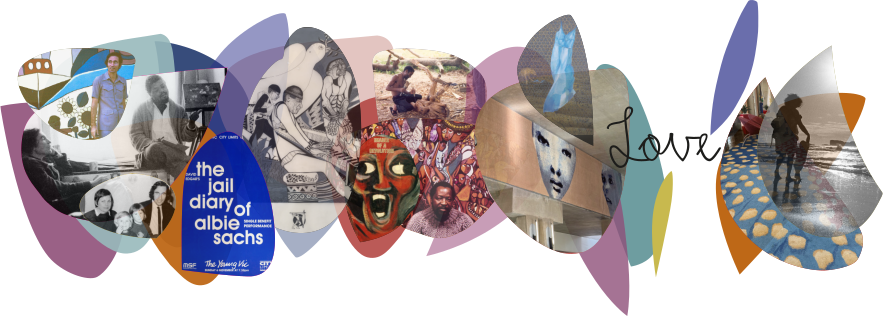
..a love of humanity, expressed in all its forms
The myriad manifestations of love in Albie's life


In celebration of the Zeitz Museum of Contemporary Art Africa exhibition Spring is Rebellious: The Life & Art of Albie Sachs, the initial focus of this chapter will be on the love and significance of culture in Albie’s life, with new material added throughout the course of the exhibition from 24 July 2025 - 23 August 2026.
Koyo and Albie in conversation
On 25 July 2024, Albie and curator Koyo Kouoh, sat down for an in-depth conversation about art, law, passion, reason, curiosity, and all things ‘life and love’. This was in preparation for the Spring is Rebellious: The Life & Art of Albie Sachs exhibition at Zeitz Museum of Contemporary Art Africa.
These short videos are extracts from that remarkable conversation, accompanied by the full conversation text after the last episode.
Radical Friendship
Africanity, Creativity and Connection
A Quiet Radicality
Art, Power and the Refusal to Be Defined
Congruencies
and the Practice of Compassion
From Oppression to Emancipation
Justice, Passion and the Power of Art
Belonging to an Entire Continent
Full conversation between Albie and Koyo transcript paper edit
Albie Sachs Why? Why is there such an amazing bond between the two of us? We would seem to have nothing in common. I'm from Cape Town, cosmopolitan world. White background, grandparents from Lithuania. You from West Africa. Growing up French speaking, I'm growing up English speaking. And yet there is something strong between us.
Koyo Kouoh For me, it's very simple. People who are filled with love and generosity meet, and when they meet, they connect, and I think that it's spiritual somewhere. You know, those people find each other wherever they move around in the sphere. So that connection is, I think, because we have similar sensitivities, we have similar subjectivities, and we are both filled with passion. Passion is, I think, one of our major connectors.
I grew up being fascinated and in admiration for the struggle in South Africa. I grew up hearing my elders, my parents, people around me, who were politically active, talking about South Africa all the time. My very first passport that I got [when] we were going for a first holiday outside of Cameroon, and I got this passport to travel with my mom and my sister. I opened the passport and read ‘this passport is allowed everywhere but South Africa’. And South Africa was handwritten in very nice lettering. And my eight- or nine-years old brain did not understand what that means. So, and I didn't really ask because I like to be in a space of my own imagination, I was like, what has Cameroon against South Africa? Or what has South Africa against Cameroon, that a Cameroonian citizen could not travel to South Africa. I was very intrigued by it. Later, of course, I found out why, and I found that it's not, it's not Cameroon who didn't want Cameroonian citizens to travel to South Africa. It's South Africa who didn't want Cameroonian citizens to travel to South Africa.
Albie Sachs It was both.
Koyo Kouoh Exactly, yes. So since then, South Africa has been part of my imagination, part of my consciousness, part of many, many things. It's only when we really met, in that first week I was here that I was like, ‘Oh my God, that's Albie Sachs.’ So, I think that to come back to what binds us, why do we connect so deeply and so steadily and so continuously and evolving? Also, because our relationship is… I find it so rich and so extremely human and extremely detached of any sort of interest, so to speak. Of course, I have interest in Vanessa’s food. Can I make jokes like that? And I have to say this, and I say to you all the time, you were the first people to welcome me properly in Cape Town. You were the only people who understood what it means to move to Cape Town as a non-South African as the other African, so that that sense of hospitality, which for me, is a lot, just knowing how to host people, hold people, you know, care for people, is an amazing skill that very few people have the way you and Vanessa happen to, and I embraced it, and I fell in love with both of you.
Albie Sachs And it's connected with art. There's somehow an unstated, but an assumed affinity in relation to creation, representation, people. It's different poles of Africa with different backgrounds, but the Africanity is important. And radicalism. It's one of your words. It's the radicalism and the art, plus the general friendship and warmth and fun. In my case, one of the things I'm astonished by is your use of English language. Is it your fourth language or your third language? Your fifth language? Sixth language? Seven! I'm always astonished. But you know, those of us who are in what was once upon a time the British Empire, there's something of the Anglo preeminence in our heads. English isn't a language. It's the universal mode of expression. All the other things are languages. So, we're not comfortable with other languages. Black people in South Africa are comfortable with many languages, but people from my background, not very comfortable. And I'm amazed at how it's a kind of refined, subtle, thoughtful, expressive way you have, and maybe it's because you didn't grow up in the Anglo world, that you use the language with those little incongruities that give it flavour and spice that are particularly nice.
I think the radicalism is very important, and it's a funny radicalism, because you are in a powerful position, and you're the CEO and you're in charge, and you take that mantle, and you're dealing with rich people and property owners and millionaires and billionaires, and you're a radical. I grew up in a revolutionary family, and radicalism was my mother's milk. My mother very modest, quiet, very self-deprecating. She was good at crossword puzzles, but she didn't finish her schooling. Never went to university, not really into books, but very strong, radical intuitions and thought and loyalties and vision of the world. And I think so much of what that combination creates is not just intellectual, certainly not just political, it's not just sympathy, it's not just spirituality, not just Africanity. It's somehow that combination, and I suppose even curiosity comes in.
Koyo Kouoh Yes, curiosity [and] all of that. But I would like to go back to your idea of me sitting at a position of power and being surrounded by so-called millionaires. I am an exhibition maker. Art is very close to wealth and has always been close to wealth and power. A lot of my colleagues, curators, we like to say that we are wealth adjacent. Means that we spend a lot of time dealing with wealthy collectors. But that doesn't mean that we are. So that's one thing. And the other thing that I would like to add to that is also that your upbringing is not that different from mine, coming from Cameroon, coming from a post-colonial, post-war country. We’re the first or second generation of so-called elite. I'm a daughter of a boomer, and they were really the first people to get certain higher education and enter this sphere of public life and public service. But still, at the same time I was raised by my great-grandmother and my grandmother, so I sometimes I like to say that I was born old, because I was always surrounded by people of a certain age and I have the culture of people of a certain age. What I want to say with that is that I come from a very modest background as well. So, the curiosity, the eagerness to learn, to make it in life, is imprinted in you, just from your condition, so to speak, because you want to improve, you want to be better. And I also think that beyond that kind of social condition that I come from, I'm a driven person, extremely driven in everything I do, be it at work, be it in family, be it friends. When I say driven, it's also profound and complete. So, I think that there are many similarities, and I think that it is those similarities that also bind people in friendships, because you may seemingly come from extremely difficult or different backgrounds, but people are about their own essence, and your own essence is what makes you, and you grow affinities and similarities with people who come from the same essence - for me, South Africa, and particularly you and others, but particularly you. Over the past five years, have I've learned so much just by sitting at this table on Sundays and having meals. This is better than the entire encyclopedia. You know, my husband, who loves you as well, sometimes says you should really record Albie.
You’re talking about me, and I'm responding to you talking about me. It's really not about me, it's you. It's really you who provides that emotional space, provides that amazing home, provides that access to you, to your mind, to your heart, in ways that is extraordinary. It is really extraordinary, providing this access, without any form of distinction. Anybody can come here, so long as they are interesting and they are interested. So long as they are kind and respectful, they will be welcome, and you will always have a moment and the time for them. And the other part that I really admire with you and that we share is your capacity for listening. You can be so quiet and just listen and listen and listen and listen and listen, which is a capacity that is not given to a lot of people. Most people cannot listen. Even when they listen, they don't hear. You listen and you hear, and that is, I think, something that we share as well. I am the same.
Albie Sachs So now I'm thinking of as you're talking of other things… We are both very rooted in the places where we grew up, but we both love the world. We love our part of all humanity.
Koyo Kouoh We love the world, because the world is always larger than where you are from or where you are used to being. And going places gives you perspective. It is important to see other places, to meet people who are not necessarily from your environment. It is important to understand how the world is connected, because we are all connected. And I'm not talking about tourism. I hate tourism. I'm talking about travel - meaningful, mindful travel; travel that is motivated and infused with curiosity, with care, with knowledge. Knowledge intake as well as knowledge production. So, it is extremely important to see the world. That's why mobility is a political matter. You know, that's why certain people can go everywhere, and other people are restricted to move. This country has a big story about restriction of mobility.
I've always been interested in the world. As I was growing up, we didn't have the possibility to travel, as I do now for work. But you can also travel also just to… I've traveled through literature. I travel just through reading novels, and that will take me places just through the story. And we need to keep that curiosity and that care about the world that is beyond us. And one of the things that I always regret is this isolation that a lot of countries, or a lot of people, have. The idea that there is something to preserve. But everything has to change as well. That's evolution. That's totally normal. So yes, the cosmopolitanism, I'm very curious about the world. I still want to do all the 54 countries of the continent. That's one of my aims before I leave this journey. But I'm quite good. I think I'm at 25 so I still have some to do.
Albie Sachs Let me just mention why it's been so inspirational having you here. In part you came to this monumental, spectacular building. In a sense, it's a huge blessing. In a sense, it's a curse, because it demands something. You can't just have something nice. You've got to have something grand and special. But it needs that kind of imagination. It's partly that you love ideas. You respect ideas. Thought is extremely important, but you're not acting thought. You think, as an active person, as a woman, as an African woman, as an intellectual, as a radical, and you get things done as a result. It's not just wishes. So, it's hugely impressive, and maybe it's very special me, for me as an African. South Africa was cut off from the continent by apartheid. People came to work. They were sent back to their countries. It was cut off, not simply by restriction of movement, and not simply by the apartheid attacks on neighboring countries because they were supporting the freedom struggle, but ideologically; that assumption we are superior white civilization. And then even amongst the oppressed people. Samora Machel used to say, you know, that people who were oppressed by the British felt they were superior to the people oppressed by the Portuguese.
Koyo Kouoh And those oppressed by the French even more.
Albie Sachs They were. And then those oppressed by white South Africans felt they were superior to all the other oppressed peoples in Africa, and imbibing the Afro-pessimism and the assumptions about Africa and incompetence and disaster and being kind and nice to poor, starving people and so on. And that kind of imagery and imagination was really strong. I had the huge blessing, as it turned out, of living in Mozambique just after independence, feeling the immense energies, the thoughtfulness, the cultural expression, and I also felt the price that Africa was paying for our liberation. And it's not known in this country at all.
Koyo Kouoh Well, because the apartheid government didn't want South Africans to know what all these other African countries are doing for the liberation of South Africa. I remember when Obasanjo became president of Nigeria, he opened a whole line of budget just for South Africa in the 1970s, Senghor opened the first ANC office outside of South Africa in independent Senegal in 1962, and I know that a lot of South African citizens could arrive at any Central and West African border without any sort of South African identification. Egypt did a lot… But to bring it back to South Africa, that this part of this engagement of other African countries for the liberation of South Africa is not known. Now that I've been here for five years, I'm understanding a little bit more of the story of the country and the structures, particularly the structures of oppression. One of the main tools of oppression is to keep people dumb, to keep people uneducated, because once you educate anyone that you're oppressing the next thing they want the power and the liberation. So, by keeping people uneducated you keep them down.
… When the museum was launched, it was really a joy in the field of contemporary art, in the field of art in the continent, widely. We were all extremely happy that an initiative like that is being is done, and that this is coming together. I am a die-hard Pan-Africanist. I don't think that there are Senegalese or Cameroonians or South Africans and Congolese - of course there are, but we are all Africans. And I think that the entire continent belongs to me, and I belong to the entire continent, from Tunis to Cape Town and from Dakar to Djibouti. So, all of that plays in this mind, and I always live my Pan-African ideals in my work, in my life, in many ways. So, me coming to South Africa was just going to another part of my big home, which is Africa. But to bring it back to the museum, it was important for me to accept that call, because I think that a museum is a very important site of conversation. It's a very important site of storytelling, and it's an essential site of knowledge production, particularly the knowledge that stems from art. Because art is a social science, as I say a lot, it's a social science that has its own vocabulary, has its own grammar, and has really its own way of reading and writing life. And for me coming to really make the museum, I felt it as a duty on the one hand, and also, I felt you we cannot leave this to South Africans alone, because unfortunately, South Africa from the insularity, as an outcome of that insularity, tend to be extremely naval gazing and only looking at South Africa. So, I'm also here to participate in the expansion of the understanding of South Africa and its position within the continent. And it is also reflected in our program. You know, we are the only institution in this country that are showing artists that are not South Africans. For instance, all the other institutions are, you know, 95% - 98% of the time only showing South African art. And it is important to have that programme. And Cape Town is one of those historically very important sites of conversions, or at least of passing, for the story of the continent. That you were talking about radicality earlier, the radicalism, I would like to go back to that. A lot of people believe that being a radical is being a protester, being like on the streets, being an activist. You can be very radically quiet and make things happen without lots of noise as such.
Something that you said earlier also linked to radicality is that I'm very opinioned. In a sense, on issues of race – unforgiving; on issues of women, gender – unforgiving. And I think that the past five years of living and working in South Africa has even reinforced my unforgiving about issues of race. For me, it's urgent. Everything is still so urgent. But actually, I should ask you the question because you have such a trajectory. You can look back to so much in terms of how the questions of race have developed in South Africa. What would you say there?
Albie Sachs I can say the change has been huge, enormous. That young people don't know that. And maybe it's good they don't know.
Koyo Kouoh I'm not sure it's good they don't know.
Albie Sachs I love our agreements, but I love our disagreements even more. And when I spoke once, very recently, about African artists, you were resistant to that idea of African art. The Africans who are artists, but they're artists, they were artists. So, the idea of the Metropolitan Museum having a special section of African art, I thought, yes, great, an opportunity for the people from the continent, continent of origin, to find space to be acknowledged for commonalities, to affirm themselves, to interact. And I think I'm being progressive, and I discover right off that artists want to be artists. They don't want the label, they don't want the etiquette, the assumption that is this peculiar thing of Africanity. Now, how do you respond to that?
Koyo Kouoh Well, I have multiple responses. But here I'll give you this one. Art is a social science, and like any social science, it is practiced everywhere, at any moment and continuously. I believe that even currently, now in Gaza, there are artists who are making art even in the worst possible condition. You can't repress it, because it's an expression that needs to come out... these ideas that come to you. I don't necessarily believe that there is European art, there is Asian art, in what's happening. But then again, we are products of our environment, we are products of our history, of our spaces of imagination. So, from that perspective, of course, you have particularities, and in Africa we have developed some of the greatest art that exists, and some of the art that really has influenced the world, in many ways. What I don't agree with, and I'm against, is the essentialisation that white people have brought into reading the practices, the artistic practice, the artistic production of people who are not from the Euro-American sphere, so to speak. And that stems from somewhere - the idea of enlightenment, classification, modernism, and colonialism. So, to want to constantly define who is what, and particularly the idea of defining what is what, is basically also at the same time telling you 'but you are not this,' right? So, it's a form of exclusionary language, basically, which is purely racist, which we know. So, I defend art from the continent from the perspective of its essence, from the perspective of its plurality and diversity, always. But I would always be against essentialisation when it comes to singling out and saying that, okay - particularly when you use an example as a museum like the Met, which is one of the biggest encyclopedic museums in the world, which has, you know, wings for this, wings for that, and they had Egyptian wings since ever. And I liked when I go to the Met and speak to people that I like to tease them. 'So, what do you do with your Egyptian wing now? You move it to the Africa section?' 'Oh, no, but Egypt is...’ You see the joke?
Albie Sachs You know, about the exhibition. We had the team sitting around here. There was somebody dealing with the rights, somebody else dealing with this, someone was dealing with that, somebody else with the other.
Koyo Kouoh I'm very excited about the project, because I've never done a cultural history show, and for me, I love doing new things, and I love doing things that I haven't done before, because I think that my creativity is particularly activated when I'm doing things new. And also, when I came to the museum, one of the thinking strands that keeps coming and that we haven't sort of settled or kind of locked in a project yet, is the history of protest in South Africa, and this project, 'Spring is Rebellious' about you, your life, your work, your art, gives me the possibility, really, to imagine and compose - I like the idea of compose because it sounds like music - and compose like a symphony, you know, of multiple sonnets, of multiple choruses. Because you encapsulate all of that. You encapsulate all of that incredible, rich and engaged history of South Africa. And it's not just South Africa. It's really about freedom.
I visited the Constitutional Court in in Joburg, many, many years ago, before I moved to South Africa, and I was already then impressed by the collection. I didn't know that it was put together by one of the sitting judges, you know, and it's only later, when I met you that I understood how instrumental you've been. I mean, I can still hire you as a curator too, you know... I was trying to make a joke.
And the part of you that I'm really, very, very impressed by is your knowledge, not just love, but really love for art, for sure, but really your knowledge of art. The way you speak about art, the way I've heard you speak about art over the past five years, sometimes I'm in such awe that I sometimes imagine we should have Albie as a guest curator to museum one day. And so, the collection that you put together at the Constitutional Court is extraordinary. So extraordinary that I think even you know some of the savviest contemporary art curators wouldn't have made the kind of associations that you made. And by knowing that more than half of the works were special commissions. In curatorial practice, commissioning is one of the most difficult parts of curating, because you don't know what you get, basically. You put in a commission, you develop an idea with an artist, but it's a new work. And a new work there are always risks that it's either good or bad.
Albie Sachs We had competitions for certain sites, and a small committee to decide, and the rest was what we could get. I say it's a collection that collected itself, because we didn't have any funding. And I think if you've got funding, there's usually a chief person who decides, and it's usually his or her, usually his art that comes there. When you've got no funding, you take what you can get, and it's got a serendipitous quality, and we took what we could get, and sometimes with a nudge and a push.
Koyo Kouoh It’s interesting that you say that, but it doesn't feel like that. Those collections that are put together in kind of a haphazard way, [where] you take what you can get, you kind of feel it as a professional. I didn't feel like the collection of the Constitutional Court was put together in terms of ‘what we could get.’ I think that the artists who are represented, or those that you approached, were very conscious about the importance of the site, and that they wanted to contribute. Because you have some very important names.
Albie Sachs Some galleries were very supportive. Sometimes it's work that wasn't moving in the gallery. In fact, you spoke about a symphony. I used to love going to the Symphony concerts every Thursday night in Cape Town. I'm in and out of jail. When I'm out of jail, I go to the concert. So, I love the idea of the symphony. And I've got two movements, and the one movement is Mozambique and its revolution, love, war, death. Those themes come into it with a very strong visual and also an audio element. And another section would be Constitution Hill. And there's a lot of history in both. And then there is a certain personal narrative that is, in some ways, the story of Albie, the story of South Africa and the story of Modern Art, and how they became intertwined in different ways. So, I'm thrilled to bits that there's going to be a space in that extraordinary building. I'm thrilled to bits that your organising mind and your palpitating heart are going to be in charge of it.
Albie Sachs You said something that should have been challenging, but you said it as though isn't it obvious to everybody. About law and art being congruent with each other. Now that's not normally understood. Normally, law is seen as rationality, detached…
Koyo Kouoh Law is absolutely not rational...
Albie Sachs ... and then art is seen as emotional and wild and anarchic, and telling its own story of its own way. Now you say the two go together.
Koyo Kouoh Yes, they are very close from for me. If I look at it from a contemporary sense, or at least, let me put it from a modernist perspective: Our current understanding of art is very, very close to law because law, in general, permeates the entire society. You need law everywhere, or jurisprudence if you want, everywhere. There is not one field of life that is not reliant on law. But to come back to art, from a modernist perspective, the way that art has become commodified has become classified in the way that It has really been held in a space between wealth, law and practice. It is very, very dependent on legal frameworks, not just for its circulation, for its acquisitions and so on. That's one part of it what I mean that law is very, very close to art, and that, you know, artists, to some extent, are also reliant on law.
But there is another perspective that I like to think about art and law as really very close disciplines, is that if you imagine a legal framework, it is really a set of forms of reading, basically, and a set of forms of interpretation, which, to some extent, art also provides - a framework of reading and interpretation. And you need creativity. A good lawyer is an amazing performance artist and who is creative in ways to read the law for their clients. A good judge the same, in many ways. So, I think that there are very close similarities in terms of processes of how artists work, or a lawyer, or a judge can work. Somehow, I see a lot of similarities.
Albie Sachs I would add something where you're going. It's storytelling, and storytelling about human beings and relationships. And judges, in particular, are great storytellers within a certain framework, with a certain palette, with a certain audience, a certain mode, modality. But ultimately, it's about people and relationships and existence and meaning, and art is also about meaning.
Koyo Kouoh And translation and interpretation.
Albie Sachs And challenging meaning. So, there are very big overlaps. And I think when law is used for purposes of oppression, same legal language, same legal instruments, but not to enable people to express themselves and be emancipated and lead their lives, but to stop them from doing that, it's telling a terrible story, a horrible story, a negative story, a dark story. But when law is in touch with the human heart and feeling and aspirations and the pains and the joys and the puzzlement and the tragedies, and that big range of emotions that people have, when law is aware of that and responsive to that, it becomes better law. These don't undermine, in that sense, the elements of subjectivity that go with life, of living people, subjective human beings. They are invested in the law, in the rules that transcend the particularities of human beings in society in a particular moment, and they resonate with each other. And I certainly found in my experience as a judge, I hated the idea that judges were dispassionate, in the sense of cut off from the emotions of the world, that judges were purely rational, like almost a machine with a brain that instructs, artificially, if you like, input, what the outcomes would be like a vending machine. Judges are part of the world that they're interpreting. They live in that world, but they have a particular role. So, they have to be dispassionate in the sense of impartial, and it's often not easy accepting a certain tradition, a certain methodology, a style of work, so people have confidence in it, and they can entrust themselves to the unfolding of the law. There's a fairness built into the very nature and character of law that's so important. At the same time, it's rules that are animated by the heartbeat, by the fears.
Koyo Kouoh It’s really interesting, what you're saying. I wanted to kind of bounce back. We've been talking about law, how law as a framework is close to art, and you express the idea of storytelling. I would like to push that a little bit, just out of my own curiosity, and because we never spoke about it the way we are speaking about it now. There is law and there is justice. For me, it's not the same. I know it's generally understood that law brings justice, which is not true. So, as we are speaking, my head is kind of spinning and kind of telling me that my thinking is incomplete in terms of the parallel between law and art. But where do we put justice there? Where would you put it?
Albie Sachs What I've seen in South Africa, I've experienced. I'm not defining now, I'm living. I'm living under law that is ugly, divisive, cruel, empowering oppression, officially racialising the state, officially denying people fundamental human rights through the law. It's telling a terrible story of injustice. A little space is there to use that language that pretends to be fair to everybody, to fight little fights, to mitigate the power of the state to divide people, oppress people, prevent them from doing things that human beings should be able to do anywhere. And so we get the transformation as far as the legal framework is concerned to a constitutional democracy, with a powerful preamble speaking about the injustice of the past, the need to rectify those injustices, the need to give space for everybody to develop their talents, the need to bring about transformation and change. So, the law itself is now aiming at justice, not acting as a fortress of injustice. It's all law, rules, procedures, judges, courts, counsel, arguments, texts. We even changed our robes, so we weren't wearing the same robes as the judges who'd imposed so much injustice. We even got our own logo. We didn't want to use the old logo. We even put up our own building with a totally different style and feel. A building that was based on traditional African settling of disputes under the tree in public, everybody joining in, trying to have a court room like that, not representing the power of the state but the rights of the people. So, all of this fed into the architecture, fed into the art, and we found that creating an ambience filled with art didn't make the judges wiser, it didn't solve the legal problems, it didn't make sure that they would get the right conclusions. But we created an ambience encouraging them to feel connected with the nation, with the heartbeat of the nation, with the feelings of the nation. So that sense of rightness, of justice, of fairness would come in. And in contemporary societies where you don't have the overt injustice of apartheid, so much of justice is balancing competing rights, competing claims. People want to be free to do what they like, but sometimes what you like to do is harmful to other people. How do you balance out the different interests in that way? And there are lots of competing claims, and so there's a lot of balancing. That's part and parcel of not just classifying but balancing out. But you've got to do it in an open way. You've got to give your reasons, and the reasons are historical and cultural and political and social. They're all part and parcel of the framework, not just about the meaning of words with dictionary definitions, but the meaning of words in the lives of the people.
So, I felt, as a judge now, I'm sitting up there with my colleagues. We all have the same Constitution. Some believe in God, some believe in Jesus, some believe in Allah. Some believe there's no God, that the human spirit is important. Totally different backgrounds. Some went to the top schools for the privileged people, the top universities for the privileged people. Some worked their way up, like working in a factory, becoming a court interpreter, studying, becoming a prosecutor, becoming a judge. One, her father disappeared because of the Pass Laws and didn't come back for six months. Another one collected wine labels, especially from France. But you all have the same Constitution. How do we use that document, itself a product of history, or struggle, of people dying, of people having imagination, of people finding the language to encapsulate what we don't want to happen again and what we want to see in the future? And how do we balance our unlimited idealism and hope on the one hand, against our unlimited anxiety against corruption and defeat and negativity? The tension built into the very nature of the Constitution.
So, these are all animating principles. And a point that I've made in my writing is about the judges who become the great storytellers of our age. It used to be the preachers. And everybody would quote the preachers and the preachers' interpretation of the Bible. Now it's much more the judges, and there are judges you like, and judges you dislike, and arguments about the US Supreme Court, other Supreme Courts, and so on. But they do more than just settle disputes. They do something about the character of society, the nature of the world we live in, what it means to be a citizen, what it means to have rights, competing interests all the time. What principles do you use to balance them out? So that's the story telling. In the beginning was the word, but now it's the word in the Constitution. But we are not oracles removed from society. We're part of the society which we are judging. And that sense of humanity, participation, must be there, but the impartiality, the fairness, the justice, and all of those themes come in. So that's one of the themes I've been promoting to the discomfort of many of my colleagues, who like to feel they're absolutely neutral, they're outside, they just decide according to the law, according to rules and principles. And to me, that's not what happens in practice and it's not what it should be.
Koyo Kouoh And also, for the fact that there is hardly any objectivity. Every objectivity is always subjective.
Albie Sachs Exactly. You acknowledge it, you come out with it, you explain it, it's part and parcel of your reasoning. You don't pretend that's not why you're doing the things. Then the other theme I've been dealing with a lot is passion and reason. And normally the projection is that...
Koyo Kouoh ... passion is not reasonable...
Albie Sachs ... art is not reasonable, and law is not passionate. And that's just not true. And the belief in justice, people have fought so hard for it, and that sense of elation when something is done and said and pronounced that comes from those expressing power that's just and fair, it's tremendous. And the converse is also true. But I think the good judge is dispassionate, in the sense of being impartial, listening to everybody, understanding the arguments, giving reasons, substantiated reasons for the decisions, being transparent and open. That's on the one hand. But also filled with compassion. It's about people, the meaning of the law for people, the impact on people, on their lives. And people are not just abstract individuals, subjects of rights. They're living in communities, in neighbourhoods, in languages, in families, in their imaginations. They're always situated and contextualised. And that's what makes it so interesting, to acknowledge the huge diversity of human beings and the enormous universality and commonality and the tensions between diversity and commonality. Acknowledge those things.
Koyo Kouoh You said a key word that made me stop you. It's about compassion. I like to believe that artistic practice is a practice of compassion. It's a practice of care. It's a practice of consideration of human experience that really uses scripts and objects, forms and symbols, to complicate the reading somehow, to some extent. So, in that it comes close to law again.
Albie Sachs So even the idea of the judge being passionless, cut off, pure reason, without compassion, without emotion, without feeling, without connection with the world, it's completely false,
Koyo Kouoh Absolutely.
Albie Sachs But the idea of the artist as being a wild anarchist who doesn't think…
Koyo Kouoh …that's also completely wrong…
Albie Sachs …I think of our great artists in South Africa…
Koyo Kouoh …yes, amazing intellectuals….
Albie Sachs …amazing, and some are very erudite. They use language beautifully, like William Kentridge, Marlene Dumas and others.
Koyo Kouoh Santu Mofokeng was one of those, for me. Extremely erudite.
Albie Sachs And others, they tell stories in a soft voice. Dumile Feni. He'd tell the most amazing stories; I'd have to listen very carefully. My hearing was quite good then, and I’d have to listen very hard, but there was so much humanity. The story of the donkey who would come to the shebeen, and they always worried about police raids because black people weren't allowed to have liquor, and they loved the donkey so much, they would give the donkey some beer, and the donkey would get a little bit inebriated, and they all laughed, and the donkey became like a drinker there. And then what happens? The police want to discover the hidden beer buried in the ground, and they'd bring the donkey along, and the donkey would sniff the beer, and the donkey became a police agent, he said. And they killed the donkey.
Koyo Kouoh Sad story.
Albie Sachs It's such a soft voice, but there's so much contradiction, you know, involved just in the story. And then his drawings of people somehow conveyed that contradiction. And then the third point that I've made not in my legal writings, but elsewhere, is some people say, 'How can you spend money on art that's in the court when so many people don't have a roof over their heads, they don't have a meal.' And I get so upset when I hear that, because are you saying: Poor people only want a roof over their heads and want food? That poor people are not interested in beauty and rights and fairness and justice? And in a sense, my experience is that poor people cling to beauty even more, because of the little shreds of dignity that they can have. It might be something nice they’re wearing, something they put up on the wall, or an image. The tiny things.
Koyo Kouoh You are so right. But, you know, societies that have come to classify and have all expressions of being alive, which art is one of, being ranked in terms of what is more important and what is not, completely tend to forget that there is a holistic way of living life, and that, art, aesthetics, creativity, are part of that holistic way. I come from an environment where aesthetics are important, even within the modesty of our financial conditions. So, you could not be truer when you say that people coming from modest conditions cling even more to style and aesthetics and beauty, because it is the one of the spaces where you can valourise yourselves somehow.
Albie Sachs
So, law is not beneficial in itself. I've lived through it myself. Law, apartheid law in the statute books, in the Constitution, the power of the police coming from parliament, law was oppressive. Group areas act, race classification, forced removal, pass laws, banishment, security given total freedom to do what they wanted, to lock people up indefinitely in solitary confinement. So that was all done under the law. We'd have tiny little spaces within that to fight back, to undermine it. But basically law was oppressive. Then comes our Constitution. We spent four years getting our Constitution. And it was drafted by 490 people, the great majority of whom had been locked up, in the underground, in the resistance, in exile, in the trade union movement, the women's movement, fighting for freedom, from faith communities, elected by our first non-racial democratic elections; they drafted our Constitution. And they remembered the pains, and the 'never again' principle was so strong. And they said, look, we're living in a very unjust society, the law must make our society more just. We mustn't just defend what exists against dictators and others, we have to transform. All of that is built into the Constitution. So suddenly the whole character of law changes from being an instrument of oppression to becoming a potential instrument of emancipation. But you don’t get there simply by declaring the law. Then you have to have the legislation, the implementation, the resources, the people using their rights, civil society, everybody contributing. So, I've lived through both. I've even myself been imprisoned, thrown into jail without trial. My books were banned. I was restricted. It was a criminal offence for anybody to possess a book written by me. Even my PhD that was published in England, it was a criminal offence for somebody to have it in their possession, let alone distribute it. So, we lived through law being used as an instrument of oppression. And now we want law to be, and now I'm a judge upholding the new Constitution, interpreting it in a way that brings about change, brings about transformation. It's been very thrilling for me. But it's not easy, it's not easy to do it in a fair and balanced way, and you don't want to overcome the injustice of the past by becoming cruel dictators yourself to redistribute. And we've seen that only sadly too often, with great freedom fighters getting into power and power does something...
Koyo Kouoh …power has its own dynamic…
Albie Sachs ... to their heads, and not only their heads, other parts of their body as well, and with great negative consequences. So, for me, it's been a very, very thrilling life, and I also found that in the apartheid days, it wasn't just apartheid that was overtly very racist and wrong. The poor throughout the world didn't look to the law. The law chased them. The law was the police van. The law was on top of them. For me, Albie, as an individual, the passion of the poor, the dreams, the hopes of the poor, that law can help with their emancipation, linking up with some of the great ideas of the ages that have been fought for in many societies, against pure despotism in many different contexts and circumstances. Those grand ideas take on a new meaning when they are now infused with the passion of the poor. So, we have a text and a wonderful text with which to work, great colleagues with a lot of passion and compassion and a lot of erudition. And we fought amongst ourselves quite often, quite sharply, sometimes even with tears. It's not automatic and obvious, but a very, very thrilling kind of poetry. And the theme of art came in indirectly, in the sense of the contradictions of human life, the aspirations of human life, somehow are represented in the corridors and the walls and the doors, on the carpets and the chandeliers, that we're living in Africa, not some transposed vision of a North American view of a classical, ancient Greek or Roman kind of purity, in our own building with its own style, its own feel, and creations of our own artists, with our own logo, our own gowns. We got rid of Latin we tried to address people in a much more direct way, with a different tone of voice.
Koyo Kouoh Also in all the 11 official South African languages, which is extraordinary.
Albie Sachs In fact, we only used English, except for one judgment in Afrikaans and one isiXhosa, in particular cases dealing with questions of language rights. But people know the right is there if they want to use it.
Scroll for more