The Albie Collection

Albie on Love

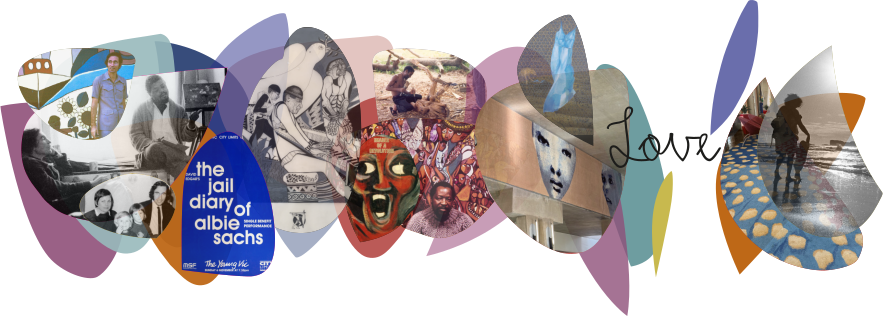
When art, life and love coalesce

A WALKABOUT

Spring is Rebellious: The Art and Life of Albie Sachs at Zeitz Museum of Contemporary Art Africa

Art, love, life, law… they just meshed with each other, reinforced each other, throughout my life.

I was extremely nervous about the Spring is Rebellious exhibition. I feared it was going to be ponderous and heavy and solemn. And the day before it opened, I walk in, and I am entranced. I’m delighted. I’m overjoyed. Yes, yes, yes, yes. It captures the way in which art came into my life, and my life came into art.

I’ve been through many experiences, and everywhere, somehow, I met up with artists. It is as though I loved art, and art seemed to love me.

From my connection with artists during the years in Mozambique, at a time of war, love, revolution, transformation and change; to a totally different connection with art from what I had in London, being with the great South African artist Dumile Feni; and later back in South Africa through the Constitutional Court Art Collection, another totally different setting, all the themes and connections I’d had over the years could somehow be poured into the ambience in which we as judges would function.

Art didn’t make us better judges in itself, but it infused those elements of judging that require imagination, a sense of humanity and a connection to life; dreams of something better for everybody; and fears of going back to the horrible things of the apartheid era. That emotional cloak, if you like, became part and parcel of the personality of the Court, and I like to feel that it has created a court in which humanity shines.

— Albie 2026

EPISODE 1 - DEEPER IMAGES

A requiem in wood

TRANSCRIPT: It's called a walkabout. For me, it's going to be a sit about. And I start with that piece of art behind me called Requiem in Wood by Mozambican artist Govane. It's unique. I don't think there's a work like it in any other museum in the world, because we filmed its creation from the very beginning to the piece that's now here; cutting down the tree in the forest, chiseling away. And there was a very strong reason for doing that.

I'd been living 11 years in Mozambique. It was huge for me. I'd been in exile in London for 11 years. They were great years. I got a PhD, married, had two children, wrote books, was on TV, but I was unhappy, even when I was happy in England. I come to Mozambique, tremendous problems, ending civil war, but in Mozambique I was happy even when I was unhappy. And what really got my goat was the way Africa was being represented in the world: as a continent of refugees, starving children, begging bowls.

For me, Mozambique was a country of intense creativity, beautiful creativity, of people reflecting profoundly on the lives they were living and producing art of extraordinary quality. And I wanted to show that. So, I'd already seen work by the artist Govane. I liked it, and together with a friend from Vienna, Margit Niederhuber – who I'd met in Mozambique – we decided to film the creation of that work.

And the film is there. The work is here. You see him chiseling away. I'm watching it. I'm amazed at how that tree trunk is not used normally. Sculpture in wood [usually] shows standing figures. He went for the knotted parts, the roots, to show the turmoil in his country. He said, ‘The story is in the wood.’ And the theme that came out [was that] he said he would look at the wood, sleep, dream, wake up, and then start working away in terms of the dream that he'd had. He said the theme was [that] a man is approaching his death, but the little strength that he's got left is to cradle two other men who are dying. It's just exquisite in feeling and emotion. And that story really is in the wood. And I'm so glad that we're going to have something to show the world, and I'm blown up…

EPISODE 2 - STORMING HEAVEN

Ideas, ideas, ideas

TRANSCRIPT: I suppose I didn't have a chance. I was named Albert after Albert Nzula; African man, trade union leader, communist, who died shortly before I was born. My dad was General Secretary of the Garment Workers Union in Johannesburg. My mom had separated, come to Cape Town, we were living near Clifton Beach.

You can see a picture of the big boy next to my little brother, Johnny, on the beach with my mom, Ray. She'd say to me and my three-year-old younger brother, ‘Tidy up, tidy up, Uncle Moses is coming.’ And Uncle Moses wasn’t Moses Cantor, or Moses Cohen, it was Moses Kotane. He was the General Secretary of the Communist Party of South Africa, and she was what was called his typist. ‘Tidy up, tidy up.’

I think of all the things my mom gave me – mother's milk, her values, her temperament – her admiration and affection and respect for an African man was the biggest gift in apartheid racist South Africa that I could have had. There he is. There's the younger me.

Part of me hated the idea that my parents expected me to follow in their footsteps. I wanted to be me, me, me, not them, them, them. Until my second year at university. I met a young crowd called the Modern Youth Society. They couldn't use the word socialist or anything touching on politics. That would have been too dangerous. The Suppression of Communist Act was very wide. People could be banned, thrown into jail, so we called ourselves modern, and it was a young crowd. I was the youngest there, full of energy, ideas, debates. We would have parties through the night, we would climb Table Mountain, we would imagine questions like, if God is all powerful, can God make a weight so heavy that even God can't lift it? Crazy ideas, but crazy ideas were just wonderful for us.

And some people remember their first kiss I remember the first time I went to jail, it was during the Defiance of Unjust Laws Campaign, and they were calling for volunteers. [Singing] ‘Volunteers obey the orders.’ And I said, ‘I want to join.’ ‘You can't.’ ‘Why?’ ‘Because you're white. It's a black struggle led by black people.’ But I was allowed to join at the end of the year – after I'd done my second-year law exams, age 17 – to lead a group of young white people into the General Post Office and sit on benches marked non-whites only. We were very brave, very enthusiastic.

Qnd it wasn't just the politics, it was the energy, the spirit, the idealism. Challenging the world, storming heaven, ideas, ideas, ideas. And culture played a very, very big role. Culture with a capital C. Culture with a lowercase c.

And we had a festival bringing in people from every part of Cape Town to express themselves through everything from weightlifting, gymnastics, boxing, football, singing, invented games. We were defying the Colour Bar. So that was so political in itself. But doing so not simply in a sloganistic way, but through expression, through doing things together.

I was amazed to discover this old film done by a friend of mine, Bubbles Thorne, using a camera in those days. And there's my mom, Ray, dancing around with other women. It was such a joyous feeling. It was like almost an image of a new South Africa, where people were just people, interacting and enjoying themselves. And there we did it.

The police would come arrest us in the end. Almost all of us went to jail. We were mostly young white people, many of Jewish background. Denis Goldberg, 22 years in jail, Ben Turok in jail, his wife Mary Butcher in jail. I'm in jail. Amy Thornton's in jail. Joseph Morolong in jail. George Peak in jail. That was just part and parcel of the project. But we knew, in the end, the whole system of apartheid was rotten, it was ugly, it was inhuman, it was degrading, it had to come down, we never, never, never lost that total, total conviction.

One of the most exciting things we did was to paint a mural. Lesley Cope, an artist a bit older than ourselves, had discovered the Mexican muralists, Diego Rivera – in the days when Frida Kahlo was the wife of Diego Rivera, now it's the other way around, he's the husband of Frida Kahlo – Orozco, Siqueiros. They took art out of the salons, out of the galleries, out of private homes, out of the cathedrals, into the street. And they painted scenes from Mexican life. And she [Lesley] said, ‘Let's do something… people's Cape Town.’ And it wasn't drinking gin and tonic on a balcony overlooking the sea, the tourist Cape Town. It was the Cape Town of the workers, of the prisoners. And we had such joy and excitement, painting, filling in the colours. The police came. They had us evicted from that building. The owner, I think, couldn't wait to get rid of what he would have seen as these ugly, ugly paintings, but it left something in my mind – the idea of public art.

EPISODE 3 - GOING HOME

Made to be with other human beings

TRANSCRIPT: Marjorie Wallace, a Scottish painter had met her husband, Jan Rabie, a rebel South African writer, writing in Afrikaans language in Paris, and she settled in Cape Town. She asked, would I sit for a portrait with her? And she told me her dad had been a barrister in Scotland, and the picture that was emerging was Albie the Advocate, rather stern. She said, ‘It's got none of your whimsy, none of your humour, none of your brightness. But it's got your thoughtfulness and sternness as an advocate.’

I took my work as an advocate very, very seriously. The very first case I got, aged 21 – I just started legal practice – was a death penalty case. Young advocates could train on death sentence cases, because nobody should be hanged if they didn't have defence. I was trembling. In fact, my client was acquitted – a woman who had stabbed her husband. Phew! The first year was terrifying. A judge would ask me a question, I wouldn't know the answer. And from the second year, third year, I had poise.

I started my legal practice with a lie. I swore to uphold the Constitution and the law of South Africa. It was a total lie. We hated the Constitution. We hated the law. But practicing in the courts, applying the law, was complicated, difficult. We could win cases, we could expose torture, we could save people from the death penalty. But overwhelmingly the courts were white judges, white police officers giving most of the evidence, everything was white, white, white, enforcing laws made by a whites-only Parliament. Difficult. And then I'm entering my chambers one day, and the next thing I know, I'm locked up. I'm in prison myself.

The door slams. I'm alone in this big concrete cube. Nothing to sit on. A mat on the floor. High window. ‘Da-da-da-dum’. I love Beethoven, giving me courage ‘Da-da-da-dum.’ And I look around, no one to speak to, nothing to read, can't write. This is inhuman. Human beings are made to be with other human beings.

I sit down on the floor, I stretch my toes, the wall, the walls, my toes. I know I'm there under the 90-Day Law. I could be detained without trial, without access to lawyers, without going to court, for 90 days in this total solitude.

The only thing from outside was noise, and occasionally I would hear chimes of a clock, little bit of traffic sometimes, but mainly the din of prison – doors slamming, metal commands, drunk people crying out, crying out, crying out, and then quietening down, and then crying out, crying.

And then one day I hear whistling. There's another human being; that's not prison sound. There must be another political prisoner. I whistle ANC songs ‘Nkosi Sikelel’ iAfrika.’ I'm whistling. No response. ‘Mayibuye’ – Come Back Africa - no response. ‘Senzeni Na, Senzeni Na.’ No response. Then I try ‘The people's flag is deepest red. It shrouded oft our martyred dead.’ No response. And then I hear [sings] and I respond [sings] – Dvořák, ‘New World Symphony’. He's in New York, he's nostalgic for his homeland, Czechoslovakia, and he picks up on what was called a Negro spiritual ‘Going Home.’ And the theme of going home means so much to me in that prison [sings], and there's somebody else, a whistler, with whom I'm communicating.

EPISODE 4 - SHEER GENIUS

Exile and Dumile Feni

TRANSCRIPT: For me, this is a very, very, very London scene. Dumile Feni, South African artist, sitting on the only piece of furniture that he had in a basement, little apartment, Tufnell Park, working-class area of London. The trunk, we travelled… none of us travelled by plane in those days. You went by boat, you put all your belongings in the trunk, and that's the only furniture he has in this apartment, pieces of screen with trousers un-ironed hanging over them, a mattress on the floor, a tap of toilet, and he's explaining his ideas about art and the people and telling me stories in his soft voice and I'm listening to him and he would often come round to my house nearby to the flat I'm then married to Stephanie Kemp, we have two little children. He loved being in a space with children, and it was warm and soft things to sit on, and he'd have some nice food. We loved having him around, and I've known many great artists, William Kentridge, South African, world-renowned handspring puppet people, South Africans world-renowned Marlene Dumas, South African-born world renowned, but for sheer genius none of them can touch Dumile Feni. He just managed with black and white imagery and a little bit of sculpture to capture something so intense, so strong, so memorable.

Everything, everything was political. Even love was political. I'm Advocate Albie Sachs, interviewing my client Stephanie Kemp in a prison in Cape Town. She had blown up pylons. She'd been braver than myself. She wanted me to be her advocate. We’re across the table and I'm falling in love. There was just something so bright, so idealistic, so proud, so vulnerable, so beautiful about her. We don't say anything. The only time I even touch her is after she's sentenced to some years in jail, not the long period that we'd feared, and I shake her hand – I had my right on then – and say, ‘Good luck, be brave.’ She comes out of prison, she comes to see me, and she says, ‘Be careful, they're coming to get you.’

They did come to get me and I'm thrown into solitary confinement again. This time it's much worse. It's sleep deprivation – noise for 10 minutes, total silence for 20 minutes, noise for 10 minutes, 20 minutes silence. Another team comes in working afternoon, night, after midnight, into the morning, and I feel I'm breaking. I'd held out completely my first 168 days. I'd run to the sea and thrown myself into the water. It was joyous. Now I was collapsing. They pour water on me, pry my eyes open, and I start breaking. The worst moment of my life, the worst moment of my life. I leave. Stephanie and I decide we will marry. We'll go to London. Okay, with a sense of defeat, but [also] elation; I'm not going to be raided, I'm not going to be thrown into prison. My telephone is not going to be listened to; I'm not going to be followed. My car is not going to be interfered with.

I lie on Hampstead Heath, and I see the kites flying, and I just feel so safe, so safe. And yet, for all my wonderful friends in England, and powerful anti-apartheid movement, and access to art and culture and music and learning this subject and that subject and the other, teaching law, getting to know things I can bring back to South Africa, in England, even when I'm happy I'm unhappy.

Mozambique. Independence, revolution, ‘zona libertada da humanidade’ – ‘liberated zone of humanity.’ A whole new lifestyle for me. A country where even when I'm unhappy, I'm happy, because I'm so close to the issues. I'm back in Africa. We're trying to build a new society. Wonderful artistic expression, cultural expression, completely new. I'm overwhelmed, I'm joyous.

The Spring is Rebellious walkabout continues. More episodes will be released here soon.

Continue Exploring

The link has been copied to your clipboard.